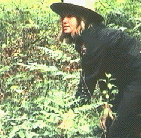
 CK pauses to point out poison ivy. She says
it grows in many habitats and is especially well adapted. "People are
the only animals that get poison ivy rash." About 50-60 different kinds
of birds eat its berries.
CK pauses to point out poison ivy. She says
it grows in many habitats and is especially well adapted. "People are
the only animals that get poison ivy rash." About 50-60 different kinds
of birds eat its berries.
After demonstrating the use of measurement tools, the Ranger
led the class to a field site, on the way she pointed out plants and other
features of the ecosystems.
CK stops at places along the trail and points out plants to the students.
She explains that the kind of plant changes as we enter areas where soil
has developed on top of the dune.
CK pauses to point out poison ivy. She says
it grows in many habitats and is especially well adapted. "People are
the only animals that get poison ivy rash." About 50-60 different kinds
of birds eat its berries.
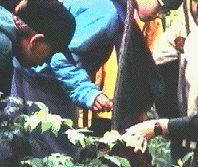 She identifies a plant that has three different
leaf shapes at various locations around the plant.
She identifies a plant that has three different
leaf shapes at various locations around the plant.
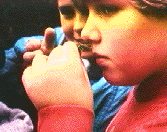 She breaks off a leaf from a mint plant and
passes it around for the students to smell.
She breaks off a leaf from a mint plant and
passes it around for the students to smell.
She points out a spider wort.
CK stops to point out a mole hole. She says she thinks it is a mole hole
because it is near a mole tunnel. She points out witch hazel and says that
its wood was used to make divining rods when settlers searched for water.
Its liquid is used for cleaning.
We are now in a new habitat, the oak forest. CK points out some pine trees
that do not belong there. They were planted near a house that used to be
in this area. CK also points out bracken.
Next she points out false Solomon's Seal. Why seal? Because the roots, if
you dug them up, are shaped like a seal. Solomon was a king who studied
botany, so they called it Solomon's seal.
We inspect a black berry. CK explains that it grows in the "micro-climate"
that is formed along the trail side when more light reaches the ground because
of the trail opening. A boy asks whether there is poison oak. CK says, "It
is not supposed to be in this region." She says that in the wetlands
there is one poisonous rattlesnake. Katy says that she has seen poison ivy
vines as thick as a branch.
CK points out "a new kind of grass."
"Is it Marram grass?"
"No," say the kids.
"Good," she replies, "Why is the marram grass not here?"
"Because it is a different habitat." respond the kids.
CK explains that there is sand here beneath the soil. "You are walking
on the dune. Long ago this was a dune and there was marram grass. This is
an example of succession, the process by which it became an oak forest.
Succession is the changing of plants that grow in an area over time. As
plants moved onto the dune, they decomposed and made soil. As the soil increased,
different plants were established in the more abundant soil.
It is raining lightly on us.
We look for animals. We listen for birds. CK explains that different birds
live in different habitats. Mega notices some ants on a plant. CK responds
by saying that they look like "flying ants." and adds, "good
observation."
CK tells us we are now near the wetland and we will
take a set of measurements here. After taking measurements at the first
site, we move down the trail to the second site.
We start down the trail. The kids walk by many holes and neat things they
do not see except for when things are pointed out at a stopping place, directed
by CK.
We are now entering the oak savanna habitat. CK says it "needs to be
burned to get rid of all the baby oak trees. The flowers don't grow unless
the area is burned." she explains. She stops and points out a lovely
lavender flower, lupine.
We start off again down the hill. They move fast, loving
the sense of run-falling down the slope. Mr. Sitz (gym teacher) comments
to me, "The kids need that, a little bit of burst of energy. They need
to take a break."
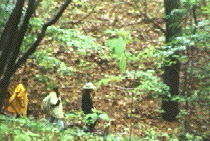 The path becomes slippery. CK stops the kids
and warns them that it is slippery and they should slow down. Then she sets
the pace by leading the group slowly, taking the lead position followed
by a long line of children snaking down the steep path.
The path becomes slippery. CK stops the kids
and warns them that it is slippery and they should slow down. Then she sets
the pace by leading the group slowly, taking the lead position followed
by a long line of children snaking down the steep path.
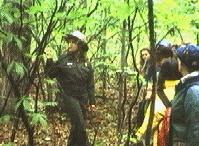 At one point we stop to listen for animals.
CK thinks she hears a red squirrel.
At one point we stop to listen for animals.
CK thinks she hears a red squirrel.
She tells of hearing three different birds, each in a different
habitat. A whipper will in the woods, a great horned owl in the wetland
and a woodcock in a grassy area.
I notice, as we move down the path, that the size of the group pulls it
along, down the trail. It is a magnet that keeps kids from stopping to explore.
It channels the kids down the path, they do not disperse, their attention
is directed by CK, the focal point/leader.
Katy stops to inspect a tree. The group moves on, but then she realizes
it is a sassafras tree. She does back to take a photograph.
On the trail, E Whispers to J, "Beware of the cat."
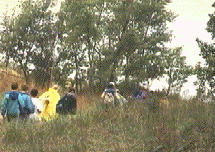 We leave the oak forest and cross to the dunes.
The lake is below us.As she starts down to the lake, R
calls back to K, "Mrs. Beck, this would be a good poem thing."
K tell me that the students are writing poems about habitat.
 The kids are down on the beach, listening to
CK.
The kids are down on the beach, listening to
CK.
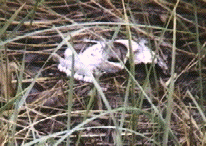
The teachers have found a skull in the dunes. Rick Sitz
says, "I'd say its a dog."
He comments on the teeth shape.
Katy gets some film from me to photograph the skull.
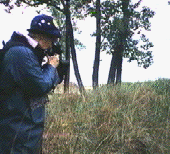 She says, "I'm sorry the kids didn't see
this."
She says, "I'm sorry the kids didn't see
this."
Rick thinks that other parts of the animal must be around
here. He looks around at other places near the skull.
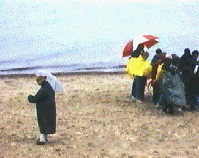 Meanwhile, the students are on the beach below
us, gathered around CK, listening to her. Charlotte (the art teacher) is
sketchingon the beach. (Later Charlotte showed me her sketch pad. She explained
that she was trying to match the subject with various media she would have
the kids use to sketch these habitats
back at school.)
Meanwhile, the students are on the beach below
us, gathered around CK, listening to her. Charlotte (the art teacher) is
sketchingon the beach. (Later Charlotte showed me her sketch pad. She explained
that she was trying to match the subject with various media she would have
the kids use to sketch these habitats
back at school.)
The kids are released to look at the water. Some kids start to skip stones.
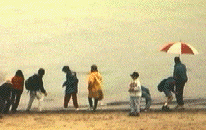 Soon, all the kids are lined up along the waters
edge, throwing stones.
Soon, all the kids are lined up along the waters
edge, throwing stones.
Rick picks up a stone and says, "This is going to
be a fiver."
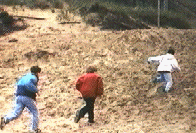 CK calls to the kids, "Okay, you can run
up the dune now."
CK calls to the kids, "Okay, you can run
up the dune now."
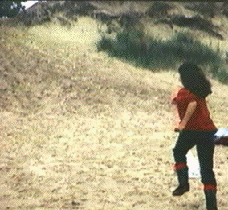 The kids peel away from the lake and run toward
the dune.
The kids peel away from the lake and run toward
the dune.
CK calls out, "You have about one minute, then we
have to go."
A minute later she calls to the kids,"All right, pack
up, we have to go."
We walk the road back to the ranger station.
Katy falls back with me and two girls. she stops to show the girls a seed
pod on a plant along the road. She stops to exclaim at a pine filled with
pollen at the new growth of cones. She takes a photograph.
We board the bus. The teachers check for seat belts. We go to the Mt. Baldy
area where we will eat lunch.
Return to Field Trip Menu